


The Siberian, from its origins to the present day
From Siberia to Russia
His Origins
The Siberian, also known as the Sibirska Koschka or Sibi, is an ancestral cat that has been known to man for centuries. Although it lived in the wild in Russia, its origins remain partly hypothetical. It is generally agreed, however, that it is the result of a cross between :
-
The domestic cat brought to Siberia by Russian settlers
-
The indigenous wild cat, particularly from the central Siberian plateau and the Ural mountains
From a genetic point of view, studies have shown that the FGF5 gene, responsible for long hair in felines, may have emerged in domesticated populations exposed to cold climates. In the Siberian, this mutation is thought to have been naturally selected, favouring survival in harsh environments.


From Siberia to Russia
Siberia (Сибирь, Sibír') makes up the Asian part of Russia, covering 13.1 million km², or 77% of the country's surface area, but home to just 27% of its population. Its harsh continental climate, characterised by extreme winters of up to -30°C, makes animal survival difficult in the absence of human companionship.

For a long time, the region was populated by nomadic tribes, limiting the possibilities for domesticating wildcats. The hostile environment - long periods of snow, the presence of carnivores such as wolves, lynxes and foxes - favoured robust felines with an adapted morphology.

The Russian Expansion and the mutation of the Siberian
Long inhabited by pastoral populations speaking Ural-Altaic languages, Siberia was gradually colonised by the Russian Empire from the XVIIᵉ century onwards.
Expansion began with the occupation of the northern fringes before extending to the coasts, bypassing the Caspian gates. Following the Russian Revolution, the Caucasian territories were Sovietised under the name of the Socialist Republic. The Soviet regime continued logging and initiated mining, gas and oil extraction in the XXᵉ century.
The mass arrival of Russian settlers was accompanied by domestic cats from Central Asia and the Middle East. Invaluable rodent hunters, these cats naturally became part of the daily lives of sedentary and agricultural populations.
The Russian Expansion and the mutation of the Siberian
Long inhabited by pastoral populations speaking Ural-Altaic languages, Siberia was gradually colonised by the Russian Empire from the XVIIᵉ century onwards.
Expansion began with the occupation of the northern fringes before extending to the coasts, bypassing the Caspian gates. Following the Russian Revolution, the Caucasian territories were Sovietised under the name of the Socialist Republic. The Soviet regime continued logging and initiated mining, gas and oil extraction in the XXᵉ century.
The mass arrival of Russian settlers was accompanied by domestic cats from Central Asia and the Middle East. Invaluable rodent hunters, these cats naturally became part of the daily lives of sedentary and agricultural populations.


It is highly probable that the "semi-long-haired" and "long-haired" mutation occurred in Russia (Transcaucasia) and that it spread to Turkey (Angoras) and Persia (Persians). The Siberian has a clearly identifiable phenotype and is probably the eastern subspecies of the European wood cat, whose habitat extends to the Caucasus and Asia Minor.
Cats originating from the Middle East differ markedly from the classic shorthair. This divergence is the result of a variety of genetic origins: Middle Eastern semi-longhairs are thought to have received a significant proportion of genetic material from crosses with different species of wild and domestic cats.
Among these ancestors, Felis lybica, the African wild cat, plays a fundamental role. It was from this species that the first feline domestications took place, around 9,000 years BC, in the Fertile Crescent (present-day Iraq, Syria and Israel). Felis lybica lybica, the subspecies most often cited in genetic studies, is considered to be the direct progenitor of the modern domestic cat (Felis catus). This feline, naturally sociable and more tolerant of human presence, is thought to have been attracted by the grain stores and rodents of the first Neolithic villages.


Felis Silvestris Lybica
Over the millennia, descendants of the Felis lybica have spread throughout Europe, Asia Minor and Central Asia. There they met and sometimes hybridised with other wild subspecies such as Felis silvestris caucasica or Felis silvestris silvestris. This cross-breeding enriches the genetic diversity of cats in these regions, giving rise to more robust populations that are better adapted to a variety of climates - particularly the extreme conditions of Siberia.
Even today, different subspecies related to the Siberian can be distinguished. In Transcaucasia, for example, a wild cat known as Felis silvestris caucasica bears a striking resemblance to the European Felis silvestris silvestris.
*** Translated with www.DeepL.com/Translator (free version) ***
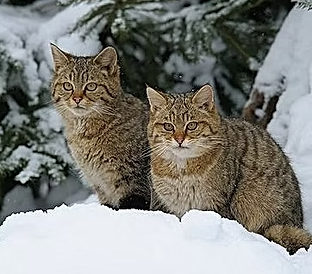
Felis Silvestris Caucasica
The Siberian has developed naturally, without human intervention. Its thick coat with a high insulating undercoat and medium-length hair has enabled it to adapt to Siberia's harsh winter climate.
The Siberian's thick fur is made up of three distinct layers (topcoat, intermediate coat and woolly undercoat), a morphological adaptation comparable to that seen in the Arctic fox or Siberian wolf.

Worldwide distribution of Felis Silvestris. http://www.wikipedia.org
From nature to official recognition
The Siberian developed naturally, without human intervention, until the XXᵉ century. Under the Soviet Union, pet ownership, especially of pedigree animals, was heavily regulated, if not discouraged. This explains why the Siberian remained unknown to the international cat world for a long time.
The first official mention of Siberian-type cats appears in the illustrated book Brehms Tierleben, published in 1925 by Alfred Edmund Brehm, which mentions a semi-long-haired cat living in the Caucasus.


Siberian leopard cat Prionailurus bengalensis euptilura Elliot, 1871
The first modern cat shows were held at London's Crystal Palace in 1871, although the very first documented gathering dates back to a fair in England in 1598. The Siberian was shown there under the name "Russian Longhair", but without official recognition.

The first official cat show at Crystal Palace. (Book ‘Practical Cats’ by David Taylor.)
From Russia to Europe and the world
It wasn't until 1984 that Siberian cat breeding officially began in Russia, in Leningrad (now St Petersburg), under the impetus of the KOTOFEI and KIS cat clubs. The first standard was drawn up in 1987, then revised in Frankfurt in 1988.
In the meantime, German engineers working on laying gas pipes in the USSR discovered these cats and brought several back to Germany, particularly to the Leipzig and Berlin areas. Among them, Hans and Betti Schulz, founders of the Newskij cattery, became the first European breeders of the breed with MUSSA, a red tabby and white female, and TIMA, a male, both imported from St Petersburg in 1987.
The fall of the Berlin Wall in 1989 made it easier to export the Siberian to Western Europe.
In 1990, the World Cat Federation (WCF) finalised an official standard, including all the traditional colours as well as colorpoint colours, known as the Neva Masquerade (Newskaja Maskaradnaja). At the time, only around fifteen Siberian cats were known to exist in Western Europe.
That same year, American breeders Elizabeth Terrell and David Boehm of Starpoint Cattery imported the first Siberians to the United States from St Petersburg. To everyone's surprise, these cats quickly won prizes against the Maine Coon, considered to be the feline icon across the Atlantic.
From Russia to Europe and the world
It wasn't until 1984 that Siberian cat breeding officially began in Russia, in Leningrad (now St Petersburg), under the impetus of the KOTOFEI and KIS cat clubs. The first standard was drawn up in 1987, then revised in Frankfurt in 1988.
In the meantime, German engineers working on laying gas pipes in the USSR discovered these cats and brought several back to Germany, particularly to the Leipzig and Berlin areas. Among them, Hans and Betti Schulz, founders of the Newskij cattery, became the first European breeders of the breed with MUSSA, a red tabby and white female, and TIMA, a male, both imported from St Petersburg in 1987.
The fall of the Berlin Wall in 1989 made it easier to export the Siberian to Western Europe.
In 1990, the World Cat Federation (WCF) finalised an official standard, including all the traditional colours as well as colorpoint colours, known as the Neva Masquerade (Newskaja Maskaradnaja). At the time, only around fifteen Siberian cats were known to exist in Western Europe.
That same year, American breeders Elizabeth Terrell and David Boehm of Starpoint Cattery imported the first Siberians to the United States from St Petersburg. To everyone's surprise, these cats quickly won prizes against the Maine Coon, considered to be the feline icon across the Atlantic.

Les Felis Silvestris Caucasia. http://www.arkive.org

The Felis Silvestris Europea. © Neva Star
In France, Siberian officially appeared in 1991. It was recognised, along with Neva Masquerade, by the WCF in 1992.
The Siberian's pedigree must reflect its Russian origin. Some final adjustments to the standard were made in Paris in 1995, in collaboration with the Livre Officiel des Origines Félines (LOOF) and the Cat Fanciers Federation (CFF). Mr Imran Okulov, a former member of the KOTOFEI board, and Dr Phil. Irina Sadovnikova proposed a new version of the standard, which was accepted by the WCF.
In 1997, the first Siberian Neva Masquerade arrived in California at the WILLOWBROOK kennel. That same year, the breed was also recognised by the Fédération Internationale Féline (FIFé), followed in 1998 by the international cat association TICA, which nevertheless adopted its own standard.
The Siberian breed is now officially recognised, but is still relatively unknown to the general public.
The first show devoted to Siberian cats in France was held on 22 January 2006 in Thiers, bringing together 25 representatives of the breed, including classics and Neva Masquerades. The event was organised by the Société Féline Auvergne Bourbonnais Limousin (SFABL) in partnership with the association Chat-de-Sibérie.
Recognition and feline authorities
Siberians are now recognized by the main international cat federations:
-
FIFé (Fédération Internationale Féline): this federation brings together a number of European countries and has recognised the Siberian since 1997.
-
The Fédération Féline Française (FFF): a partner of FIFé, it works to promote the breed in France.
-
The LOOF (Livre Officiel des Origines Félines): the official French organisation responsible for keeping the feline pedigree register, it has adopted the Siberian standard in collaboration with Russian clubs.
-
TICA (The International Cat Association): very influential in North America, it has accepted the Siberian since 1998, with a separate standard.
These institutions contribute to preserving the breed standard, registering bloodlines and promoting the Siberian cat at national and international cat shows.
Recognition and feline authorities
Siberians are now recognized by the main international cat federations:
-
FIFé (Fédération Internationale Féline): this federation brings together a number of European countries and has recognised the Siberian since 1997.
-
The Fédération Féline Française (FFF): a partner of FIFé, it works to promote the breed in France.
-
The LOOF (Livre Officiel des Origines Félines): the official French organisation responsible for keeping the feline pedigree register, it has adopted the Siberian standard in collaboration with Russian clubs.
-
TICA (The International Cat Association): very influential in North America, it has accepted the Siberian since 1998, with a separate standard.
These institutions contribute to preserving the breed standard, registering bloodlines and promoting the Siberian cat at national and international cat shows.


